
Is Your Sterling Silver Jewellery Really Sterling Silver? What You Need to Know Before You Buy
Have you ever stopped to think about what's actually in the jewellery you're buying?
A piece might be advertised as sterling silver, have a little 925 stamp on it and look just like the real thing. But does that necessarily mean it is?
Unfortunately, no. And some recent findings from a BBC investigation make for some pretty shocking reading.
The results are quite alarming
BBC Watchdog, featured on The One Show, recently investigated 25 pieces of jewellery purchased from popular online marketplaces including Etsy, Amazon, Temu, eBay and OnBuy. (You can see the article here )
The pieces were sent to Sheffield Assay Office for testing, and the results were quite staggering.
Out of the 25 pieces examined, only TWO could actually be classed as sterling silver.
Yes, just two.
The remaining pieces contained less than the legal requirement of silver to be sold as 925 sterling silver.
But that wasn't even the most concerning part.
Eight of the pieces contained illegal levels of cadmium, with some containing as much as 10%. Cadmium is a toxic heavy metal and a known carcinogen. The permitted limit in jewellery is just 0.01%.
It's shocking, but if I'm honest, not entirely surprising. With so much jewellery being sold online at incredibly low prices, it's worth asking what corners are being cut to make those prices possible.
And this is why I think it's so important that customers understand a little more about the jewellery they're buying.
What does 925 sterling silver actually mean?
Let's start with the basics.
Sterling silver isn't pure silver. It's an alloy made up of 92.5% pure silver and 7.5% other metals, usually copper.
Pure silver is relatively soft, so adding another metal helps to give it the strength and durability needed for everyday jewellery.
When you see 925 stamped on a piece, it's supposed to indicate that the metal is 92.5% silver.
But here's where things get a little confusing.
Anyone can stamp 925 onto a piece of jewellery.
And I mean anyone.
There is no magical process involved in putting those three numbers onto a piece of metal. The stamp itself doesn't prove what the jewellery is made from, and it certainly doesn't guarantee that it meets the legal requirements for sterling silver.
So, what should you be looking for instead?
The difference between a 925 stamp and a hallmark
This is something I think every jewellery buyer should understand, particularly when shopping online.
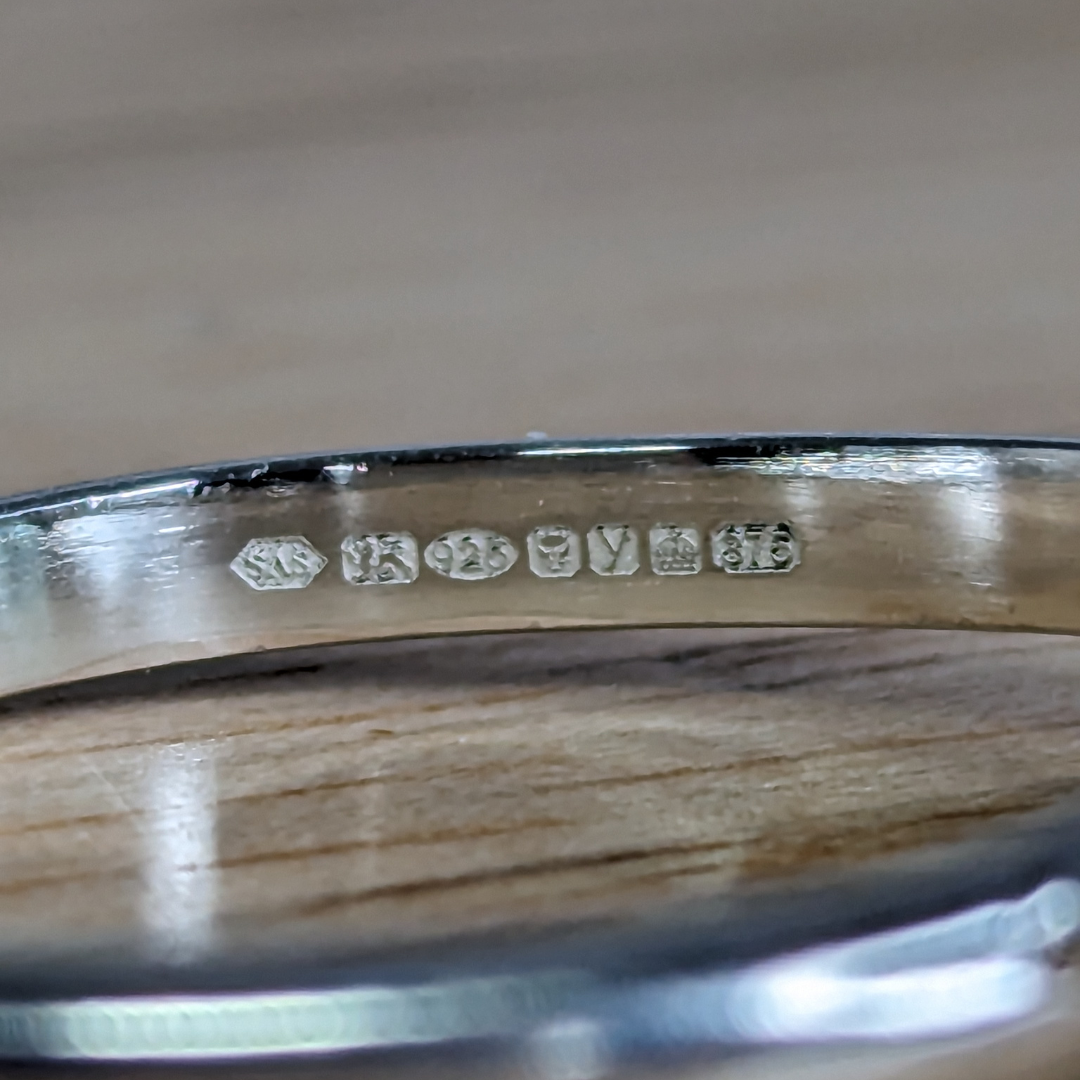
A 925 stamp is simply a fineness mark. It is an indication of the metal content, but on its own it isn't independent verification.
A UK hallmark is different.
Hallmarking is carried out by an independent assay office, where jewellery is tested to establish its precious metal content. Once it has passed, the appropriate hallmark is applied.
In the UK, there are four assay offices, and a hallmark gives you independent reassurance that the precious metal content is what it claims to be.
There are, however, some exemptions to compulsory hallmarking.
For silver, any article weighing less than 7.78g is exempt from the legal requirement to be hallmarked. This doesn't mean it can be made from whatever someone chooses and still be sold as sterling silver. It must still meet the legal fineness standard.
And importantly, being exempt from hallmarking doesn't mean that a piece should contain unsafe or prohibited levels of metals such as cadmium.
So, how can you protect yourself when buying jewellery online?
This is probably the most important part, because I know how difficult it can be to distinguish between genuine handmade jewellery and mass-produced pieces when you're browsing online.
There are a few things I'd recommend looking out for.
1. Look at the price.
This is often a good starting point.
If you're seeing sterling silver jewellery advertised for a couple of pounds, alarm bells should start ringing.
Silver isn't a cheap material to begin with. Once you factor in the cost of the metal, labour, tools, overheads, packaging and the cost of running a business, genuine handmade silver jewellery simply cannot be produced and sold for next to nothing.
Of course, price alone doesn't prove whether something is genuine, but it is worth questioning how a seller can offer precious metal jewellery at such incredibly low prices.
2. Look for the dealer's notice.
In the UK, anyone selling precious metal articles, including online retailers and resellers, is generally required to display a dealer's notice.
This is something you should be able to find both in a physical shop and on an online store.
You can find mine on my website under the Hallmarking section. (View it here)
It's a small detail, but it shows that the seller is aware of their legal responsibilities when selling precious metal jewellery.
3. Have a look at their social media.
This is particularly useful when buying from independent makers.
Can you see them actually making their jewellery? Do they share videos from their workshop, talk about the materials they use or explain how their pieces are created?
Do they show an understanding of the metals and gemstones they're selling?
You can often get a really good feel for a business by spending a little time looking through its social media.
Of course, not every legitimate seller will share their making process online, but it's another way to get to know the person or business behind the jewellery.
4. Don't be afraid to ask questions.
This is probably my biggest piece of advice.
Whether you're buying in person at a craft market or shopping online, ask questions.
Ask what the jewellery is made from. Ask whether it's solid sterling silver or silver plated. Ask about hallmarking and where their materials come from.
Any good jewellery maker or reputable seller worth their salt should be more than happy to talk to you about their materials and how their jewellery is made.
If someone can't answer basic questions about the jewellery they're selling, I'd be inclined to look elsewhere.
Why buying genuine handmade jewellery matters
As a small independent jewellery maker, I spend a lot of time thinking about the materials I use, the quality of my work and the pieces I'm putting out into the world.
I work with recycled sterling silver and gold, carefully selected gemstones and traditional jewellery-making techniques. Every piece takes time, from working with the metal to those little finishing details that make all the difference. If you'd like to know a little more about me, my journey into jewellery making and what goes on behind the scenes, you can read more about me here
And that's something I think is often overlooked when we're shopping.
When you buy a piece of handmade jewellery, you're not just buying the metal or the finished product. You're buying the time, skill, knowledge and care that has gone into making it.
I'm certainly not saying that everyone needs to spend hundreds of pounds on jewellery. There are lovely pieces available at different price points, and there's nothing wrong with looking for something affordable.
But I do think there's a difference between affordable jewellery and jewellery that is being sold cheaply at the expense of quality, safety and honesty.
You deserve to know what you're buying, what it's made from and that the person selling it is being honest with you.
And ultimately, that's what I want customers to feel when they buy from me. That they can wear and treasure their jewellery knowing exactly what it is, how it was made and the care that went into creating it.
Because when it comes to precious metals, what something is made from really does matter.

Comments