What is Hallmarking About and Why We Do It
The History of the Hallmark
The UK hallmark has quietly protected jewellery lovers for centuries. Long before mass production, goldsmiths were required to have their precious metals tested at an Assay Office to prove their quality and honesty. It dates all the way back to the 1300s, when each piece was stamped with tiny marks to show who made it, where it was tested, and that it truly was the silver or gold it claimed to be. I love that tradition still exists today. It feels like a small promise pressed into the metal. A mark of trust, craftsmanship, and care that connects every handmade piece to generations of makers before us.
If you’re curious, I’ve linked the Assay Office page below, where you can dive deeper into the history.
Why should you ask about hallmarking?
Perhaps it's not the first thing to come to mind for most people when buying jewellery. But it is important.
Precious metals are alloyed with other metals to give them strength and workability. For example, 925 sterling silver is 92.5% silver and 7.5% other base metals, such as copper. 9ct gold (375) contains 37.5% pure gold, with the remainder an alloy of other metals. There is no way to test the precious metal content by eye, to know you are purchasing the real deal, as advertised; it needs to be tested. It is a legal requirement to do so. Jewellery that weighs below a certain threshold is exempt from hallmarking regulations in the UK.
The exemption thresholds are:
Silver under 7.78g
Gold & Palladium under 1g
Platinum under 0.5g
All weights above these require hallmarking.
**It is worth noting now that if you purchase mixed metal pieces, such as silver with gold accents, the exemption weight automatically falls to the gold weight, which would be 1g. Therefore, all mixed metal pieces must have a hallmark regardless of their single component weights.
If you are purchasing or selling jewellery in other countries, you need to be aware of their hallmarking laws and their exemption weights. Some require a Common Control Mark, and others have completely different exemption weights. Some require you to have a registration within their own Assay Offices, too, so it pays to do your research.
How do you get a hallmark?
Jewellery is sent to one of the UK Assay Offices, with which the maker/seller is registered with. I am registered with the London Assay Office. We weigh the jewellery pieces and fill in a hall note that describes the jewellery and the metal content. The assay office tests the jewellery for the content of precious metals that the jeweller has declared. If it passes, then it receives the hallmark.
The UK Hallmarking Act (1973) states it is an offence for any person, trade or business to describe or supply an unhallmarked piece as being made wholly or partly of precious metals. Sellers who fail to comply with hallmarking regulations may face severe penalties, including substantial fines and legal action.
All sellers are also required to display the statutory notice, known as a dealer's notice, including when selling online - you can see mine here - I also have a printed laminate copy that I display on my stalls. Look for the dealer's notice; it is your guarantee when purchasing.
So what does a hallmark consist of?
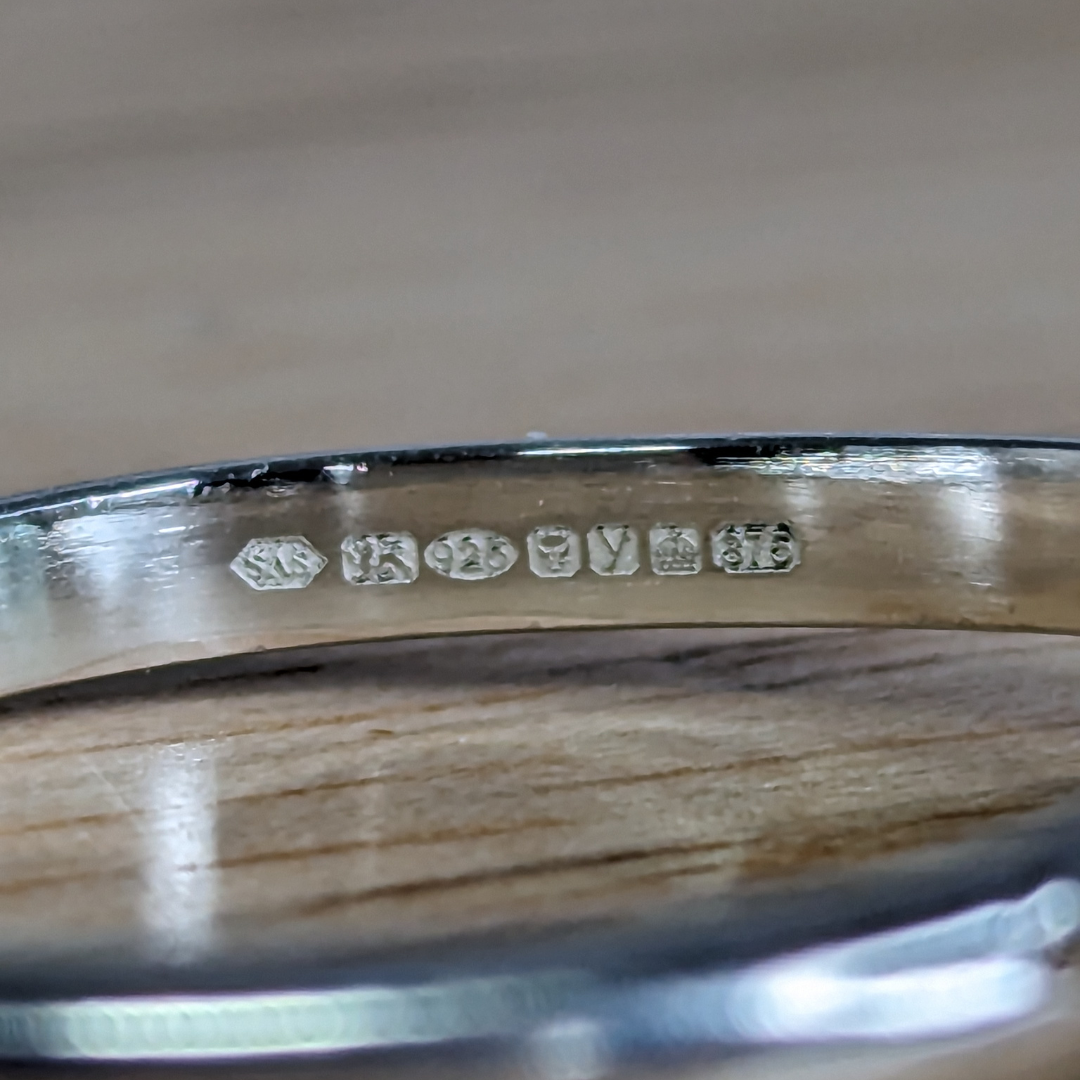
It is 5 symbols that are either struck by hand punches or laser-engraved onto the jewellery.
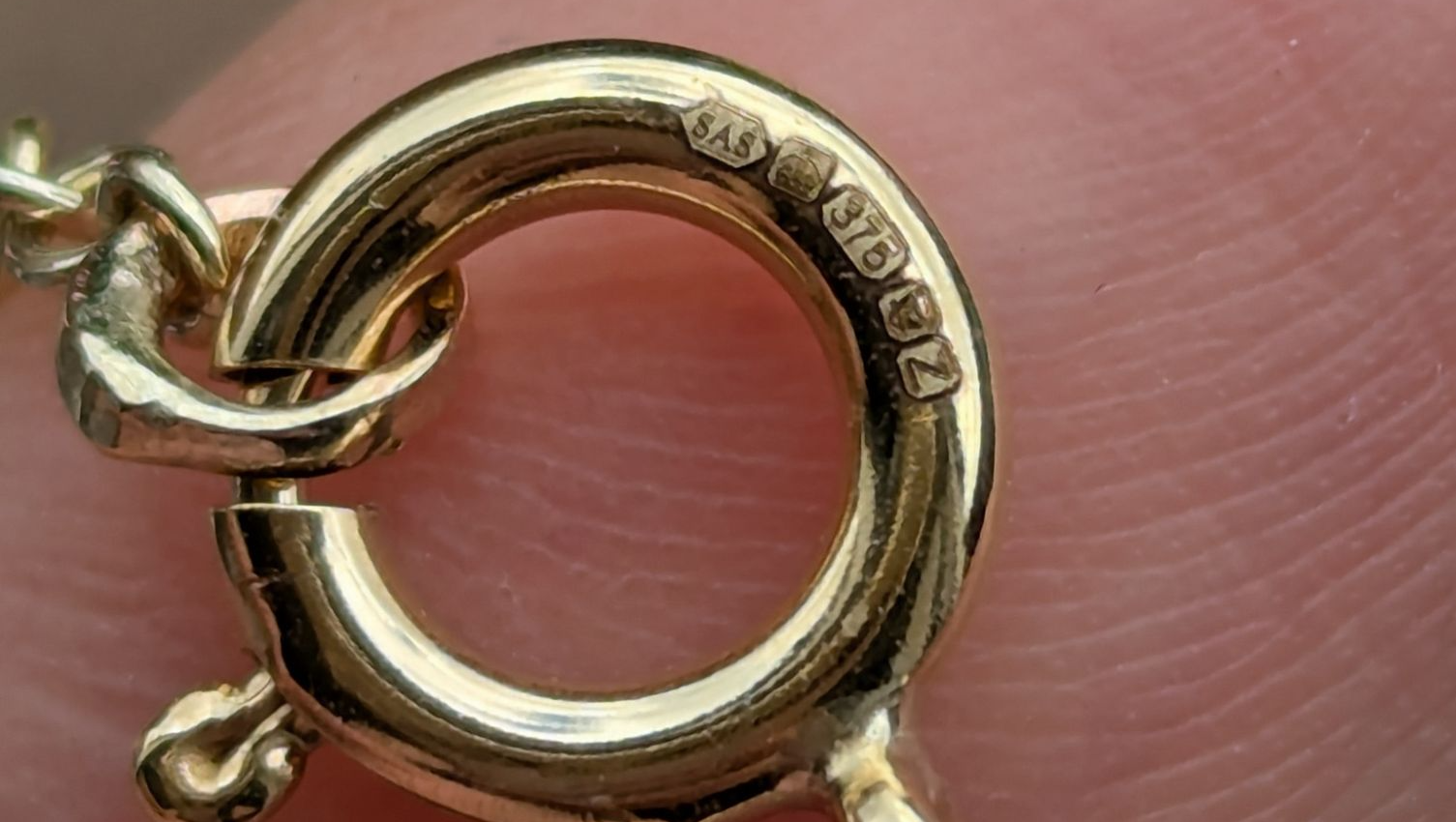
Sponsor’s Mark (also known as Maker’s Mark) - That is the registered mark of the maker, a set of initials upon a shield. Each one is unique to each maker. No two are the same - below is a piece featuring my unique Maker's Mark and the full UK hallmark.
Traditional Fineness Symbol - Symbols depicting Sterling silver, Britannia silver, Gold, Palladium and Platinum. This is an optional mark, but is applied as standard at the London Assay office where I am registered.
Millesimal Fineness Mark - This tells you the metal's quality and type. It is the number part of a hallmark within a shield, so for silver, you would see an oval shield with 925 in the middle, 9ct gold is a hexagon shield with 375 in the middle.
Assay Office Mark - There are 4 assay offices in the UK: London, Birmingham, Sheffield and Edinburgh. London is the Leopard's head.
Date Letter Mark - The letter corresponds to the year the piece was made.
My jewellery is stamped 925, so it must be silver, right?
Not necessarily, these stamps are readily available online for a few pounds and are not tracked or registered. I know some people have been caught out where they have purchased jewellery with a 925 stamp, but later discovered it was in fact a plated base metal rather than sterling silver.
Some do choose to stamp their underweight silver with the number 925. It's not a hallmark, but if you are buying from a reputable place and you have seen their dealer's notice, then it's most likely fine.
If unsure, just ask the seller. I am sure they will be more than happy to help.
The steps I take to ensure my customers know exactly what they are buying...
All the jewellery I create that is above the exemption weights will always have a full hallmark. All my mixed metal pieces will always have a hallmark.
For my underweight pieces, I mark them using my Maker’s Mark. The London Assay Office provided me with my unique registered maker's mark. That way my pieces are traceable to me, who knows one day they may end up on an antique programme!
When purchasing from me you can also request any piece under the exemption weight to be hallmarked if you would like it to be.
So that is everything you need to know about hallmarking. Whether buying jewellery for yourself or selling it as a business, I hope this is helpful. If you have any questions just pop me an email here.
Why not head over and check out some beautiful jewellery rest assured that you know it's exactly the quality as stated - www.streetscraftcreations.co.uk
Happy jewellery buying - Shell x
Comments